It’s been quite a while since I last posted, so I am going to have to brush over a lot here for the sake of time. Since my last entry, I have been to
Okay. Because there seems to be so much to cover, I think I’ll write this post a bit differently. I’ll just do a section on work at the clinic, a section on our travels, and one on random experiences. Finally, to force you to make it to the end of my painfully long entries, I am going to add a “Bendles” section for fun. Maybe this will have to become a tradition with the rest of my posts. The Bendles section will just include a few quality quotes from our beloved Dr. Bender from the week before. Let us begin.
Hannan Crusade: Take Two
It seems my last post was heavily focused on an encounter with a mother and child, so I think it’s only fair that I give you all un update on their situation. Exactly one week after I first met that little girl and her mother, they returned to the clinic for more pre-treatment counseling. I was able to discover that both mother and daughter are in fact HIV-positive, but fortunately the little girl still has a very high CD4 count and does not yet need to begin treatment. In addition, the reason her mother was crying the week before was because she was afraid to tell her husband of her status. The only reason she had even been tested in the first place was because her daughter was sick and when she took her to the doctor it was encouraged that she have the child tested for HIV. Once the little girl’s test came back positive, the doctor persuaded the mother to test as well. When all of the counselors were gathering around to reassure the mother that everything would be okay that first week, they were actually offering their support to be there with her when she discloses to her husband and to provide encouragement for him to get tested as well.
I have spent a lot of time trying to understand this woman’s fear, trying to imagine being so afraid to tell your partner of your status when, in all likelihood, he was the one who infected you in the first place. I cannot wrap my head around that fear because to me it is implausible. If the husband was not loyal, my thought is that he is the one who should be afraid and begging forgiveness. There is so much talk of women’s empowerment issues and the need for women to stand equal next to men in the workplace and in greater society, but they cannot even stand as equals next to their husbands who have infected them and their babies in their own homes. I know that is a vast generalization, and certainly not all infection at home comes from men, but a very large portion of it here does. And if women have to fear being left by their already adulterous husbands, on top of the fears of their infection, how are they to be empowered? Where does one begin to help them? Certainly a lot of attention must be focused on the husbands and their roles in this mess, but in terms of HIV, families infected do not have time to wait for empowerment or equality. Treatment must be pursued, so empowerment may be forgotten.
People cannot be discussed as mere vectors or victims of disease; they need to be looked at as the still living, not the dying. With antiretroviral treatment made available to this mother, she and her child can live. Luckier than some (but still nowhere near as privileged as others), this little girl can have the opportunity to draw pictures for her mother as I did for years to come if her mother stays strong on antiretroviral therapy. But now that she has the drugs, where does that leave her as a woman? I’ve realized that ARVs will treat the illness, but not the inequality, and now this mother is putting it all in context. What if her husband does not accept her? What if he leaves? What if she has no way to support herself or her child? What good are ARVs if she cannot eat? It’s so very depressing to acknowledge that science can only go so far and society has to take on the rest. Statistics can be used to measure access to treatment, but access to the greater issue of survival cannot be measured quantitatively. So back to my original struggle to understand this mother’s fear, I suppose I will never fully understand it, because I have been born into a place where my rights and, what’s more, my value, are seen as equal to that of any man. There are no laws preventing a man from leaving his wife in my country or here, but the implications of such an event are incomparable for a woman of the States and a woman of
Look at me go again. Sorry. There is actually a reason why I am going off about women’s empowerment. Even though I have never found myself to be an ardent feminist, I have seen in this clinic the inordinate impact of HIV on women and I’ve witnessed how the virus thrives on the structure of this society. It’s a symbiotic relationship, the union of HIV and inequality requires more than medicine to combat. Poverty permeates all of these issues, but functional inequality promotes poverty, and thus this is where I want to focus my energy. I have developed a certain interest in empowerment, if only for the sake of supplementing the struggle against HIV/AIDS. I have decided to twist my research paper to focus more heavily on the ways that the Sizophila counselors have turned their own illness into economic opportunity and - here’s that hazy word once more – empowerment. I look at that mother and wonder what she would do if her husband did leave her. For all I know she could be the breadwinner in the family, but if not, would she find work? People wonder why women turn to prostitution in the face of AIDS in
The Sizophila Counselors are finding a new niche for themselves in a world that has yet to understand the obstacles that inhibit every step that some women take. In a community where unemployment hovers above 70% across both genders, what are the primary caretakers, the mothers, to do? Add AIDS into the equation, remove a generation of mothers, and reform the question: What are grandmothers to do? I still can’t believe how much this one little girl and her mother have made me think. It’s almost nerdy how much I have pondered their situation at night. I don’t have a single answer for that mother. I can’t even help her when she does tell her husband her status because she does not speak English and I do not speak Xhosa (aside from a few miserable attempts at clicks). All I can do, worthless as it seems, is to continue to think of her and her child and hope that the answers will come. But I do know this much: odds are it will be the Sizophila Counselors, the people who know the problems best, who will finally find solutions for the women of Gugulethu. WHO documents, UNDP reports and international prescriptions and recipes can try to be culturally sensitive, but the authors of those proposals will not be with this young mother when she sits down to discuss HIV with her husband, and they won’t be there in the days that follow. I take comfort in the existence of the counselors and I am desperately pouring hope into their ability to change their own corner of the world. I’ve recognized that they can do a damn good job of it, certainly much better than I ever could.
The week after I saw this little girl and her mother for the second time, I threw myself into interviews with the Sizophila counselors to explore the empowerment issue a little further. I had finally finished collecting phone numbers and data from the thousands of files and there was a lull in my workload as I waited for an upcoming meeting about the pregnancy study. I thought that maybe Nokwayiyo would find the time to sit and talk with me, and maybe even Elizabeth, the head counselor, but within 2 days I had six interviews completed. Nokwayiyo was extremely helpful in explaining to everyone what kind of research I was doing and asking if they would be willing to speak with me. We went to an empty room, and one by one, these women told me their stories. I did not yet interview any of the three male counselors, but in light of my favorite patient pair at the clinic, I was more interested in talking to the women anyway. I couldn’t believe the stories I heard. In everyday work, these women are like superheroes, impenetrable to HIV-related stigma. But in talking to them, rather than just stalking them in the counseling room, I learned that they too have been left, they too have been hurt, and they too have infected children whom they worry about. One counselor has a 7-year-old daughter who is also HIV positive, but despite her own open lifestyle, she is unable to tell her daughter that she passed on the virus to her at birth. These women are independent and lonely, experts and ill-educated, and leaders and learners, all at once. Most of them are back in school now, either finishing matric (senior year of high school) or going on for certificates in social work and peer education. Women who never thought they’d be in school again are both teaching their community and taking classes on how to better it. I am convinced that there must be more than 24 hours in their days. That or they never sleep.
I could keep going about the counselors forever. I had better just cut myself off before I start coming across like I have a crush on Nokwayiyo, because that is probably what is about to happen. She has just been so incredibly warm to me and so willing to help me in my studies that I really wish she could be a mentor to me forever. She leaves next week for a two week internship for her social work certificate, and then she will be back just as I am getting ready to go back to
PS – One of the counselors is into fashion design and is really good with a sewing machine. She told me to bring in my ripped jeans tomorrow and she is going to mend them for me since I don’t have anything with me to do it myself. I am way too spoiled by these women.
Travels
I’ll try to take this in chronological order. We had a day off from class a few weeks ago so Robin, Alison, Liz and I rented a car and drove up through the
So after exhausting our arms from rowing, we risked the reptiles in the water (hoping there were no crocs!) and went for a swim. The running joke is that I now will probably get schistosomiasis from snails in the water, but we’ll have to wait and see for that one. We made it back with all of our limbs and hopped back in the car to go watch the game. Somewhere along the way we also attempted to climb our own version of the largest sand dunes, but they were burning our feet so badly that we couldn’t even make it to the top in sandals. The dessert is A LOT hotter that I expected.
So, the Springboks. Wouldn’t it be cool to watch the Springboks play from the town of
So I was supposed to be talking about Springbok,
After the hugging and screaming died down we went back to our room to watch the news anchors travel to each major city showing the mayhem that ensued. Feeling a little left out, we just went to bed so we could get up early the next morning to sneak everyone out of the room before I checked out. Things continued to go downhill, as I killed my first ever animal on the road driving through the desert in the morning. It was a dassie, a little groundhog-like creature that clearly doesn’t value life at all. There were HUNDREDS of them in and around the road, just asking to be hit. I even gave the stupid creature the entire lane as it looked like he was on his way to the edge, but he turned and ran under my tire at the last moment. Just as I’ve mentioned in previous posts about my shrieking and insanity, I again started up my yelping and yelling at every furry animal we passed, futilely ordering them to stay out of my way. It finally got to the point that I was swerving and slamming on the breaks so much because of the plethora of dassies that everyone else in the car told me I had to choose between their lives of the dassies’. I guess I chose their’s, but I hesitated for a minute at the thought of hitting another animal. I knew Trevor would be mad at me.
I drove for a few more hours while everyone slept, the dassies finally cleared the road, and it was by far the most amazing drive I’ve ever taken. I am not going to say how fast I was going for my parents’ sake, but between the scenery and the dry wind and the endless open road, I felt more free (and drove faster) than I ever have before. I can’t put it into words, but I was probably happier driving in that desert than I was when I first got my license and could take my very first drive alone.
Okay, I am going to skip ahead to talk about our next trip to
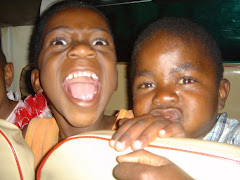
Unfortunately, we only had one day in the mountains before we left on a six hour drive to Hluhluwe, where we spent the rest of the week. We went on a game drive one morning, did a tour of a village another, and painted a 1st grade classroom on another. The game drive was beautiful, but definitely would have been better had I not gotten stuck next to Dr. Bender. I’ll come back to that in the Bendles section. The village visit was awful, the worst part of the whole excursion, but of course Bendles loved it. We walked around people’s homes, feeling extremely uncomfortable and exploitative, and the whole way Dr. Bender was getting in people’s faces and snapping photos of them. This from in PhD in anthropology. I don’t get it. Jennifer was the only smart one in the group; she chose that day to get sick and stay back at the lodge. Actually, about half the group got sick after her as well. Apparently it was food poisoning. Miraculously, my immune system stood by me and I was spared, for once. I think being a vegetarian was what saved me. But I don’t want to dwell on sickness or the village visit. The day we painted the school made up for any bad times in the village tour. I spent about as much time playing and dancing with the kids as I did painting, but I think by now I have resigned myself to limited productivity when there are kids around. We took turns teaching each other dance moves and games and then when I had to return to work they cluttered around the windows to ask us questions and watch us paint. The principal had the whole school sing a song for us and greet us, and in turn we thanked them for having us and encouraged them to finish school so they could come and paint our school on a visit to
To wrap things up, we spent our last night in
Finally, on Saturday we flew back home to
Random Experiences
I want to mention a few of the things that don’t normally make my blog posts because I am so busy writing about work or travel. First of all, I have to share that I attended my first South African theatrical production about 2 weeks ago with Dan, his roommate, Andrew, Kavita and Robin. We saw A Christmas Carol. Well, we saw a very unusual version of it. I have to say, I definitely liked it better than anyone else in our group. The story was very South African, with Scrooge being a businesswoman who ran a mine and Tiny Tim being “Tiny Tambisa”, the daughter of a miner. HIV had killed Scrooge’s sister and Scrooge then had to support her orphaned niece. The show had some cool dancing and some creative elements, but there were also a lot of comical and cheesy lines. For example, the Ghost of Christmas Present said she gave birth to Santa Clause randomly and also claimed to birth 2000 other people. That was never explained. There were many other instances like that, but my personal favorite was the way that Tiny Tambisa limped with crutches on stage but resumed her normal walk as soon as she was at the edge of the stage (and sometimes even earlier). I guess no one ever told her that the audience could still see her.
Enough about the show, it really isn’t that important. I want to tell you all about the most uncomfortable part of my days here in
Bendles
Ah yes, finally, I can get back to Dr. Bender. I would like to share a few quotes from our excursion, the first two being from our game drive and the last from our night in
1.) “You know, there’s something to be said about zoos. You don’t have to be there at 6 o’clock in the morning.” (This was said to me around 7am when we were driving through the park.)
2.) “They should just tag the animals and call us when they locate them so that we don’t have to drive around aimlessly looking for them. When is this going to end?” (This was about 3 hours into the drive, after she had been sleeping for most of it.)
3.) “I see a lot of Indians, but where are all the chiefs?” (I actually did not have the pleasure of hearing this quote because I didn’t stay with her in the hotel in
There were many more fantastic quotes. These are just a taste. But probably the most offensive thing to me was the way she spoke to our drivers the entire time we were traveling. She was so patronizing and condescending to them, openly behaving as if they were beneath her. I won’t go into more detail here because I will get too worked up and I will go on forever. I’ll save some for the next Bendles section.
Time to write a paper, folks. Hopefully it won’t be another few weeks before I can write again.


1 comment:
all I have to say is:
schisto, schisto, schistosomiasis.
Okay, so that's not all I have to say. Obviously I say hello, and thanks so much for updating. I love reading about your life. I guess you're at work right now, or at least headed that way. I hope things are going well and I'm really looking forward to talking to you this friday! Hopefully!
Post a Comment